
Why New Hires Fail: Hiring Mistakes, Skillfishing, and How to Avoid a Bad Hire
Hiring teams rarely expect a new employee to fail.
The resume looks strong. The interview goes well. References check out. Everyone feels confident that they made the right decision. Then, once the work begins, the gap appears. The employee struggles to perform at the level the role requires, the team slows down, and what looked like a great hire starts to look like a costly mistake.
That is why the question why new hires fail matters so much right now. It is not just about onboarding or culture fit. In many cases, failure starts earlier in the process, with how organizations define, assess, and validate capability.
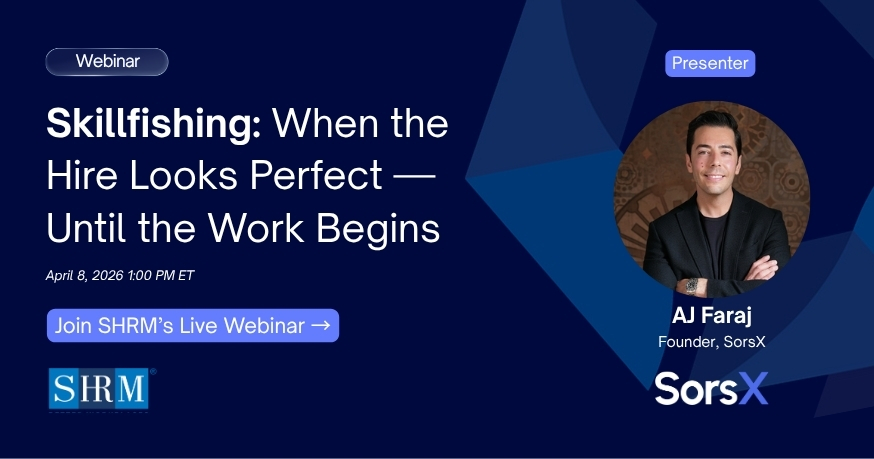
Today's hiring environment has made this challenge even harder. Candidates have more tools than ever to present themselves well. Strong personal branding, interview coaching, accelerated credentials, and AI-generated resumes can all make experience look deeper than it really is. SHRM's upcoming webinar frames this growing issue as skillfishing and explores how employers can reduce hiring risk in a more realistic way. The session is organized by SHRM and features AJ Faraj, founder of SorsX, Alex Alonso, SHRM's Chief Knowledge Officer, and Nicole Belyna, Director, Talent at SHRM and host of SHRM's Honest HR podcast.
Why new hires fail more often than teams expect
New hires do not usually fail because companies want the wrong people. They fail because hiring teams often make decisions with incomplete evidence.
Most hiring processes still rely heavily on resumes, interviews, and surface-level signals. Those tools can help, but they do not always reveal whether someone can actually perform in the role. This is where many organizations run into candidate evaluation problems. They believe they are measuring skills, but in reality they are often measuring communication style, confidence, experience framing, or the ability to interview well.
That disconnect creates an employee performance mismatch. The employer hires for expected capability, but the day-to-day work reveals a different level of execution.
Common hiring mistakes that lead to a bad hire
Overvaluing polished interviews
One of the most common hiring mistakes is treating interview performance as proof of job readiness. Interviews can reveal communication quality, preparation, and confidence. They cannot always reveal how someone solves problems, adapts under pressure, or performs in a live work environment.
This is one reason why interviews fail to predict performance as consistently as employers hope. A strong interview can create a halo effect that influences the rest of the process.
Confusing credentials with capability
Another major hiring mistake is assuming degrees, certifications, brand-name employers, or polished resumes equal real skill. These signals can matter, but they are not the same as validated ability.
This is the heart of the resume vs real skills problem. A candidate may look aligned on paper while still lacking the depth needed for the actual role.
Rushing decisions under hiring pressure
When a team needs to fill a role quickly, process discipline often drops. Interview panels skip structured scoring. Hiring managers rely more on instinct. Skill validation gets pushed to later stages or removed entirely.
That is when hiring decision mistakes become more likely. Under pressure, teams choose the candidate who feels safest, not necessarily the candidate who has been most clearly validated.
The real cost of a bad hire
The cost of a bad hire is not limited to salary. It affects productivity, morale, trust, time, and team momentum.
A bad hire can create rework for managers, drag performance down across a team, extend time-to-output, and increase turnover risk. It can also damage confidence in the hiring process itself. When the wrong person is hired into a critical role, the operational impact often goes far beyond a single employee.
That is why bad hire cost should be viewed as a strategic issue, not just an HR inconvenience. The webinar description makes this point clearly: skillfishing can slow teams down, erode trust, increase turnover, and create meaningful financial and operational consequences for employers.
What is skillfishing in hiring?
Skillfishing in hiring happens when a candidate appears to have stronger capabilities than they can actually demonstrate once they start working.
It is not always outright deception. Sometimes it is exaggeration. Sometimes it is the result of vague job titles, inflated resumes, personal branding, or coached interview responses. But the result is the same: employers make decisions based on perceived expertise that does not hold up on the job. The webinar describes skillfishing as hiring based on perceived expertise that turns out to be overstated or incomplete once the employee is in the role.
Resume vs real skills
This is where hiring teams need to shift their mindset. A resume is a marketing document. It is useful, but it is not proof. Employers need stronger ways to test whether claims align with actual skill.
AI-generated resumes and polished candidate branding
Modern hiring has made this harder. The webinar notes that AI-generated resumes, sophisticated personal branding, rapid credential programs, and interview coaching can all make candidates appear highly qualified, even when their underlying capabilities have not caught up. That creates a new layer of hiring process flaws for employers to address.
Why traditional screening methods miss the gap
Traditional screening methods often focus on efficiency, not depth. They help narrow a funnel, but they do not always validate capability well enough for high-stakes hiring decisions. That is one reason why traditional hiring fails in complex roles where execution matters more than presentation.
Why traditional hiring fails to predict performance
The biggest weakness in many hiring systems is that they are optimized for selecting candidates, not validating competence.
A resume tells a story. An interview tests presentation. Reference checks may confirm reputation. But none of these, on their own, answer the core question: can this person do this work at the required level in our environment?
That gap matters even more now because hiring risk is rising in a market where candidates can present more convincingly than ever. When employers rely too much on assumptions, they increase the chance of poor fit, delayed ramp-up, and failed expectations.
This is exactly why the SHRM webinar is timely. According to the event description, attendees will learn how skillfishing shows up in modern hiring processes, why traditional screening methods often fail to catch it, the real organizational costs when capability does not match expectations, and practical ways to strengthen skill validation and reduce hiring risk.
How to avoid bad hires and improve hiring accuracy
Validate skills before the offer
If you want to know how to avoid bad hires, start by validating the work itself. Use practical assessments, job-relevant scenarios, structured work samples, or role-specific exercises that reflect real expectations.
Use structured evaluation instead of intuition
Unstructured interviews create inconsistency. Structured scorecards, shared evaluation criteria, and role-based benchmarks improve hiring accuracy by making judgments more evidence-based.
Focus on evidence, not presentation
The goal is not to punish strong communicators. It is to make sure the decision is grounded in proof, not polish. Organizations that want to reduce hiring risk need better candidate screening methods built around real capability.
That is also where modern hiring platforms can support better decision-making. SorsX, for example, is focused on improving how companies discover and evaluate talent through AI-driven hiring workflows, which makes it a natural voice in this conversation through founder AJ Faraj's participation in the webinar.
Join the SHRM webinar on skillfishing and hiring risk
Want a clearer view of why hiring decisions go wrong and how to reduce hiring risk?
If your team is thinking more seriously about avoiding bad hires, this webinar is worth attending.
Skillfishing: When the Hire Looks Perfect — Until the Work Begins takes place on April 8, 2026 at 1:00 PM ET. It is organized by SHRM and features Alex Alonso, AJ Faraj, and Nicole Belyna. The session will explore how skillfishing happens, why it is becoming easier to miss, and what organizations can do to validate skills more effectively before making hiring decisions. SHRM Knowledge Advisors will also join live to answer questions in the chat.
For HR leaders, recruiters, and hiring managers trying to improve hiring accuracy, this is not just another recruitment webinar. It is a practical conversation about how to identify real candidate skills before a costly mismatch happens.